Most businesses don’t realize how exposed they are until something goes wrong. A single phishing email, an unpatched server, or a weak password can open the door to data breaches, ransomware, and costly downtime. And this isn’t just a big-company problem either. According to Verizon’s research, 46% of all cyber breaches impact businesses with fewer than 1,000 employees.
Managed IT services close those gaps before attackers can exploit them. They give businesses access to enterprise-grade security tools, round-the-clock monitoring, and expert support without the overhead of building an in-house security team from scratch.
What Are Managed IT and Managed Security Services?
A Managed Service Provider (MSP) handles the day-to-day management of your IT infrastructure, including networks, devices, cloud systems, and user support. It specifically focuses on cybersecurity, covering threat detection, incident response, and compliance monitoring.
Typical security services included in managed IT plans cover:
- Firewall configuration and management
- Endpoint detection and antivirus protection
- Email filtering and phishing prevention
- Vulnerability scanning and patch management
- Data backup and disaster recovery planning
- User access controls and multi-factor authentication
How Managed IT Services Improve Cybersecurity?
A strong security posture isn’t built on a single tool. It’s built on layers that work together around the clock. Here’s how managed IT services strengthen each layer.
24/7 Monitoring and Proactive Threat Detection
Cyberattacks don’t wait for business hours, and your defenses shouldn’t either. Managed IT providers monitor your network, endpoints, and cloud environment around the clock, using automated alerts and expert analysis to catch threats before they escalate.
This proactive approach means suspicious activity gets flagged and dealt with in real time rather than discovered days or weeks after a breach has already done its damage.
Advanced Firewalls, Endpoint Protection, and Network Security
Managed providers set up and maintain enterprise-grade security tools across every device on your network. These tools work as a coordinated defense system rather than isolated pieces of software.
Here’s what that typically looks like:
- Firewalls that filter incoming and outgoing traffic based on security rules
- Intrusion detection systems that flag unauthorized access attempts
- Endpoint protection on every laptop, desktop, and mobile device
- Automatic isolation of compromised devices before threats can spread
For businesses with remote or hybrid teams, this layer is especially important. Every device that connects to your network is a potential entry point without proper protection in place.
Patch Management and Regular Security Updates
Unpatched software is one of the easiest ways for attackers to get in. Managed IT teams take this off your plate by handling updates on a scheduled basis so vulnerabilities are closed as soon as fixes become available.
A solid patch management process covers:
- Operating system updates across all workstations and servers
- Application patches for tools like browsers, email clients, and productivity software
- Firmware updates for routers, switches, and connected devices
- Emergency patches for critical zero-day vulnerabilities
This removes the burden from your internal staff and eliminates the risk of a missed update, leaving your systems exposed for weeks.
Data Backup, Disaster Recovery, and Ransomware Protection
Even with strong defenses, no system is 100% immune. That’s why IT consulting and services providers make sure your data is backed up regularly, stored securely offsite or in the cloud, and recoverable within hours rather than days.
If ransomware encrypts your files, a solid disaster recovery plan lets you restore from a clean backup instead of paying a ransom. This single layer of protection alone can save a business from catastrophic financial loss and weeks of operational chaos.
Identity and Access Management (MFA, Least-Privilege Access)
Controlling who can access what is one of the most effective ways to limit damage if a breach does happen. Managed IT providers put strict access policies in place so employees can only reach the data and systems their role actually requires.
Key identity and access controls include:
- Multi-factor authentication (MFA) on all accounts and critical systems
- Least-privilege access so users only see what they need
- Role-based permissions that adjust automatically when someone changes positions
- Regular access reviews to remove outdated or unnecessary permissions
This significantly reduces the impact of compromised credentials. If one account is breached, the attacker can’t move freely across your entire network.
Getting Started: First Steps to Improve Cybersecurity with Managed IT
You don’t need to overhaul your entire infrastructure overnight, but waiting too long is a real risk. According to BlackFog research, 61% of small and mid-sized businesses were hit by a successful cyberattack. The smartest approach is to start with a clear picture of where you stand and build from there.
Assess Your Current Risks and Priorities
Before signing with any provider, take stock of your existing security posture. A thorough IT risk assessment reveals where your biggest vulnerabilities are and which areas need immediate attention.
Start by asking these questions:
- Which systems and data are most critical to your operations?
- Where are the gaps in your current firewall, endpoint, and backup coverage?
- How are employee credentials and access permissions managed today?
- When was the last time your software and firmware were fully updated?
Most managed IT providers offer a free or low-cost assessment to help you map this out. Use it as a baseline so you can measure progress over time.
Plan a Phased Transition with Clear Security Goals
Trying to implement everything at once creates confusion and stretches your team thin. A phased approach lets you tackle the highest-risk areas first and layer in additional protections as your team adapts.
A practical rollout might look like this:
- Phase 1: Deploy 24/7 monitoring, patch management, and endpoint protection
- Phase 2: Implement MFA, access controls, and email security
- Phase 3: Set up disaster recovery, backup automation, and compliance monitoring
Set measurable goals for each phase, like reducing unpatched systems to zero within 30 days or enabling MFA across all accounts within 60 days. Clear milestones keep the transition on track and make it easy to show progress to leadership.
Can managed IT services protect against ransomware attacks?
Yes. Managed IT providers deploy layered defenses, including endpoint protection, email filtering, and automated backups. If ransomware strikes, disaster recovery protocols restore your systems from clean backups without paying a ransom.
Are managed IT services suitable for small businesses?
Absolutely. Small businesses are frequent cyberattack targets because they often lack dedicated security staff. Managed IT services provide enterprise-level protection at a predictable monthly cost that scales with your needs.
Final Note
At IT-Solutions.CA, we’ve spent over 20 years helping Canadian businesses stay protected, productive, and ahead of the curve. Our team handles everything from 24/7 threat monitoring and endpoint protection to cloud hosting and full infrastructure management, all backed by 100% Canadian support.
We build a strategy around your business, your risks, and your growth goals so nothing falls through the cracks. Call us at 1-866-531-2614 or book a consultation to build a security foundation your business can actually rely on.
Author Profile

- Dedicated IT specialist with expertise in system administration, network security, and troubleshooting. Skilled at leveraging emerging technologies to boost efficiency, reduce risks, and ensure seamless IT operations while empowering teams to achieve their goals.
Latest entries
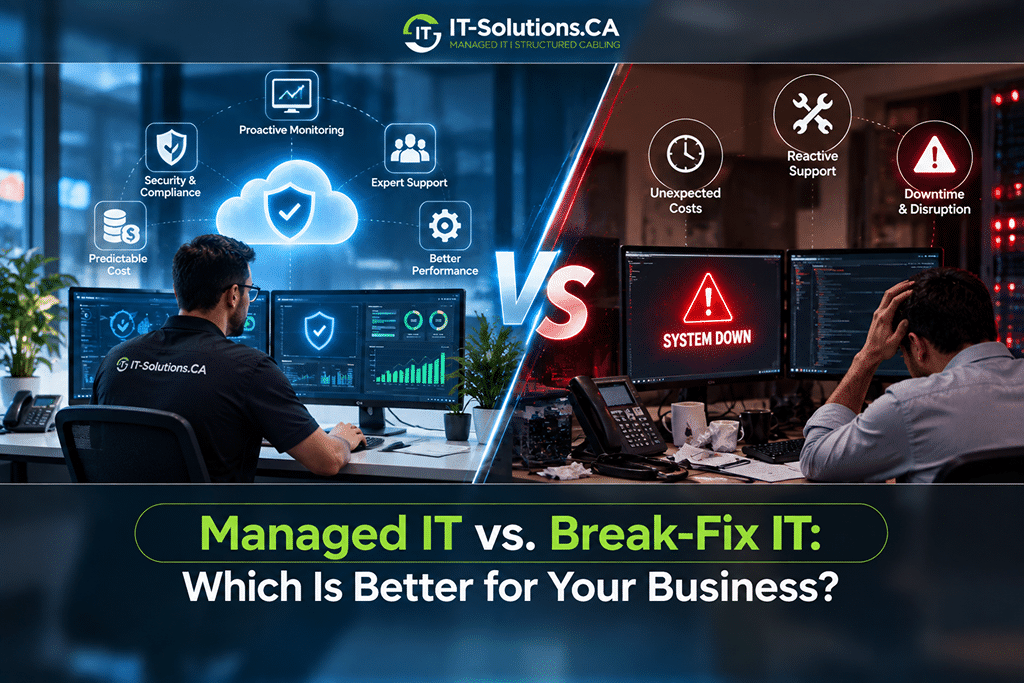
 BlogsOctober 14, 2026Managed IT vs. Break-Fix IT: Which Is Better for Your Business?
 BlogsOctober 13, 2026How Much Does A Microsoft 365 Security Audit Cost?
 BlogsSeptember 25, 2026How Often Should a Business Conduct a Cybersecurity Risk Assessment?
 BlogsSeptember 24, 2026How to Prepare Your Business for a Microsoft 365 Migration