Moving your business to the cloud is the easy part. The harder question is which kind of cloud you actually need, because public and private clouds take very different routes to the same goal. The model you choose affects your costs, your security, and how much control you keep over your data.
Cloud has become central to how businesses run, with worldwide public cloud spending forecast to reach $723 billion in 2025. Getting the most from that investment depends on choosing the right kind of cloud for your needs. Once you understand how public and private clouds truly differ, the right fit for your business becomes far clearer.
What Is Public Cloud Hosting?
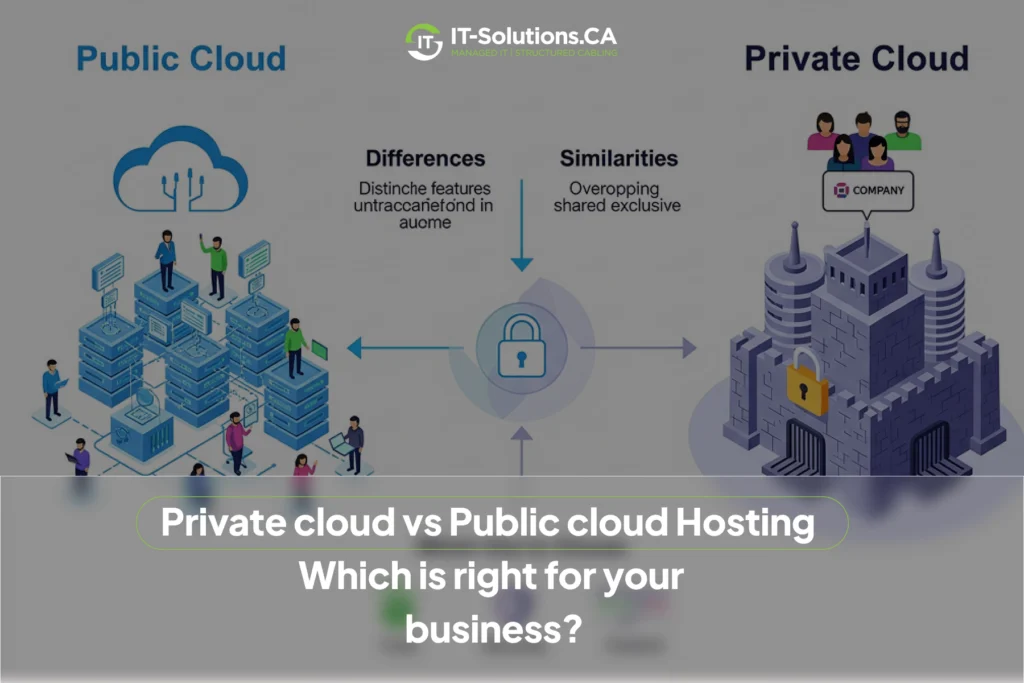
Public cloud hosting means your applications and data run on shared infrastructure owned and managed by a third-party provider. You rent computing power, storage, and networking over the internet and pay only for what you use. Familiar names include Amazon Web Services, Microsoft Azure, and Google Cloud, along with everyday tools like Microsoft 365.
Public cloud works well for many businesses because it offers:
- Low upfront cost, since there is no hardware to buy
- Fast scaling when your traffic or workload spikes
- Quick deployment without long setup times
- Access from anywhere, which suits remote and hybrid teams
There are a few considerations worth knowing before you commit:
- Security is a shared responsibility, since you use the same infrastructure as others
- You have less control over the underlying setup
- Busy periods for other tenants can occasionally slow your performance
- Costs can climb as your usage grows if they are not managed
None of these rule out the public cloud. They simply explain why it works best when someone keeps an eye on cost, access, and configuration along the way.
What Is Private Cloud Hosting?
Private cloud hosting gives your business a dedicated cloud environment that no other organization shares. All the computing resources are reserved for you, which means more control, stronger isolation, and predictable performance.
It can run in two ways. An on-premises private cloud lives in your own data center and your team maintains it, while a hosted or managed private cloud runs on dedicated hardware at a provider like IT-Solutions.CA, giving you the benefits without the burden of running it yourself.
Private cloud appeals to businesses that need:
- Greater control over configuration and security
- Predictable performance from dedicated resources
- Easier compliance with strict rules and standards
- Data residency, so you know exactly where your data lives
It also comes with a few considerations:
- Higher or steadier costs than a shared public setup
- More expertise to run it well, unless it is managed
- Scaling that takes some planning rather than an instant toggle
If it sounds like the right fit, this is exactly what we do. IT-Solutions.CA provides fully managed private cloud hosting services on dedicated hardware, with your data kept in Canada and the upkeep handled by our team.
Reach out to see how a managed private cloud could work for your business!
Key Differences Between Public and Private Cloud
Public and private clouds share the same core idea of delivering computing over a network, but they diverge in ways that affect your budget, your risk, and your daily operations.
The six areas below are where the choice really shows up.
Cost
Public cloud uses a pay-as-you-go model with little upfront cost, which suits changing workloads and tighter budgets. Private cloud usually costs more at the start or stays steady over time, yet it can be more economical for stable, predictable workloads.
The risk with public cloud is that costs can rise without oversight, as unused resources and paying for more than you need add up over time. Careful cost management matters, whichever model you choose.
Security and Data Control
Both models can be secure, but they divide the responsibility in different ways. In public cloud, the provider secures the infrastructure while you handle everything above it. Private cloud keeps your environment isolated, which gives you tighter control over how data is stored and who can reach it.
Under the shared responsibility of public cloud, you stay responsible for:
- Your data and how it is classified
- Access controls and user permissions
- Configurations and security settings
Most cloud security problems start here, since a single misconfigured setting can expose data. The more sensitive your data, the more the security model should shape your decision.
Compliance and Data Residency
For regulated industries, the cloud model can make compliance easier or harder to prove. Public cloud providers hold broad certifications, but you still need to confirm their setup meets your obligations under laws like PIPEDA. Private cloud gives you direct control over where your data lives and how it is governed, which helps with strict data residency rules.
Keeping data within national borders has become a global priority, with Gartner forecasting sovereign cloud spending to reach $80 billion in 2026 as organizations move to keep data under local law. For Canadian businesses, that means keeping data in Canada rather than trusting it to another country’s rules.
Scalability and Flexibility
Public cloud is built to flex instantly, so you can add or release resources in minutes to match demand. That makes it a strong fit for seasonal spikes or fast growth. Private cloud can scale too, but it usually takes planning and, at times, extra hardware.
If your needs change suddenly and often, that difference in speed is worth weighing before you commit.
Performance and Reliability
Dedicated resources give a private cloud steady, predictable performance, since no other tenants compete for the same capacity. Public cloud usually delivers excellent uptime through large, redundant networks, though shared infrastructure can occasionally slow down during peak demand.
For most everyday workloads, the public cloud is more than fast enough. For latency-sensitive or resource-heavy applications, the steadiness of a private environment often wins.
Management and Maintenance
Public cloud shifts most of the upkeep to the provider, which lightens the load on your team. A private cloud puts more of that work on you, unless you choose a managed option that removes the burden.
With a managed private cloud, the provider typically handles:
- Maintenance and hardware upkeep
- Updates and security patching
- Monitoring and performance tuning
- Physical security and backups
This is often the ideal balance, since you keep the control and isolation of a private setup without running it yourself.
Public vs. Private Cloud: Side-by-Side Comparison
If you want the quick version, the table below summarizes how the two models compare across the factors that matter most. Use it as a starting point, then explore the sections that apply to your situation.
| Factor | Public Cloud | Private Cloud |
| Tenancy | Shared with other organizations | Dedicated to your business |
| Cost model | Pay-as-you-go, low upfront cost | Higher or steadier, better for stable workloads |
| Security and control | Shared responsibility with the provider | Full isolation and tighter control |
| Scalability | Instant, elastic scaling | Scales with planning |
| Performance | Excellent, occasionally shared | Consistent and predictable |
| Compliance and residency | Broad certifications, verify the setup | Direct control over data location |
| Management | Handled by the provider | Yours, or handled by a managed service |
| Best For | Variable workloads, fast growth, tight budgets | Sensitive data, compliance, steady workloads |
When Public Cloud Is the Right Fit?
Public cloud is often the smarter starting point for businesses that value speed, flexibility, and low upfront cost. It tends to be the right fit when you have:
- Variable or unpredictable workloads that rise and fall
- Limited capital and a preference for monthly costs
- A need to launch or test new applications quickly
- Customer-facing apps that must scale during busy periods
- Fast growth that makes fixed infrastructure risky
- Backup and disaster recovery needs across regions
If several of these describe your business, public cloud will likely give you the speed and flexibility you need without a heavy upfront investment.
When Private Cloud Is the Right Fit?
Private cloud makes more sense when control, security, and predictability outweigh the appeal of pay-as-you-go pricing. It is usually the right fit when you have:
- Sensitive or regulated data to protect
- Strict compliance with data residency requirements
- Steady, predictable workloads that run around the clock
- A need to customize your environment in specific ways
- Legacy systems that are difficult to move to shared infrastructure
When these priorities sit at the top of your list, the control and isolation of a private cloud usually outweigh the convenience of a shared setup. Managed private cloud hosting services give you that control while a provider handles the day-to-day work.
Hybrid Cloud: Combining Public and Private
You do not have to choose one model for everything. A hybrid cloud lets you place each workload where it fits best, so you get the strengths of both.
In practice, that usually means:
- Keeping sensitive or regulated data in a private environment
- Using a public cloud for workloads that need to scale quickly
- Blending both to balance cost, control, and performance
This flexibility is why hybrid has become the default for so many growing businesses. Some also adopt a multi-cloud approach, using more than one public provider to avoid relying on a single vendor.
How to Choose the Right Cloud for Your Business?
The best way to decide is to look honestly at your workloads, your obligations, and your resources. Ask yourself these questions before you commit:
- How sensitive is the data you plan to host?
- What compliance rules or data residency needs apply to you?
- Do you prefer predictable monthly costs or upfront investment?
- How quickly and how often do you expect to scale?
- Does your team have the expertise to manage infrastructure?
- Where does your data legally need to live?
Your answers will usually point clearly toward public, private, or a hybrid of the two. If they do not, that is a good moment to bring in expert guidance.
How IT-Solutions.CA Can Help?
Choosing and running the right cloud is easier with a partner who knows the terrain. IT-Solutions.CA helps Canadian businesses assess their needs and move to the model that fits, whether that is public, private, or hybrid.
Here is how we help:
- Cloud Assessment and Strategy: We review your workloads, budget, and compliance needs, then recommend the right mix for your business.
- Managed Private Cloud Hosting Services: We run a dedicated, secure environment for you, with your data kept in Canada under Canadian law.
- Smooth Migration: We plan and handle the move so your systems keep running with minimal disruption.
- Ongoing Management and Support: We monitor, maintain, and optimize your environment so it stays secure and cost-effective.
- Local Expertise: We understand Canadian compliance and the needs of businesses across the country.
Whether you land on public, private, or hybrid, our goal is to establish a setup that fits your business today and grows with it tomorrow.
What is the main difference between a public and a private cloud?
Public cloud runs on shared infrastructure managed by a provider, so multiple organizations use the same resources. A private cloud is dedicated to a single business, offering greater control, stronger isolation, and predictable performance at a higher or steadier cost.
Is a private cloud more secure than a public cloud?
A private cloud is not automatically more secure, though its isolation and tighter control help with sensitive data. Public cloud can also be very secure when configured well, so security depends more on setup than on the model itself.
Is a private cloud more expensive than a public cloud?
Yes, in the short term, because private cloud involves dedicated resources and setup. Over time, it can be more cost-effective for stable, predictable workloads. Public cloud is cheaper to start but can grow costly at scale without management.
Can I use both public and private clouds?
Yes, and most organizations already do. A hybrid approach keeps sensitive workloads in a private environment while using the public cloud for tasks that need to scale. This combines the control of a private cloud with the flexibility of a public cloud.
Is my data kept in Canada with a private cloud?
It can be, and that is a key advantage. With a Canadian-hosted private cloud, your data stays stored in Canada under Canadian law, including PIPEDA. IT-Solutions.CA keeps your data within Canada, which supports compliance and reassures customers and partners.
Bottom Line
There is no single winner in the private versus public cloud debate because the right choice depends on your workloads, your budget, your compliance needs, and your growth plans. Public cloud rewards speed and flexibility, while private cloud rewards control and predictability, and hybrid brings the two together. The smartest move is to match each workload to the environment that serves it best. With the right strategy in place, your cloud supports your business instead of holding it back.
As a trusted IT Solutions Company, IT-Solutions.CA helps you weigh the options, migrate safely, and manage everything afterward, including fully managed private cloud hosting services, with your data kept secure and stored in Canada. Start with a free cloud consultation, or call us to talk through your options.
Author Profile

- Dedicated IT specialist with expertise in system administration, network security, and troubleshooting. Skilled at leveraging emerging technologies to boost efficiency, reduce risks, and ensure seamless IT operations while empowering teams to achieve their goals.
Latest entries
 BlogsAugust 25, 2026How Much Does IT Support Cost for a Small Business in 2026?
 BlogsAugust 21, 2026IT Risk Assessment Services Cost: A Complete Guide for 2026
 BlogsAugust 20, 2026Cloud Security Costs in 2026: Pricing, Factors, and What to Expect
 BlogsJuly 28, 2026Private Cloud vs. Public Cloud Hosting: Which Is Right For Your Business?