For years, business networks worked like an office building with a locked front door. Once someone was inside, the system trusted them and let them move around freely. That made sense when work happened on office computers behind a single firewall, but almost none of that setup holds anymore.
Today your team logs in from home, from phones, and from cloud apps that live outside your walls, and attackers know that one stolen password can carry them straight through that front door. Zero trust security is the response to that reality. It drops the old assumption that anyone inside the network is safe, and instead checks every user and device, every time. The idea has moved from niche to mainstream, with roughly 63% of organizations now adopting it in part or in full.
What Zero Trust Security Means
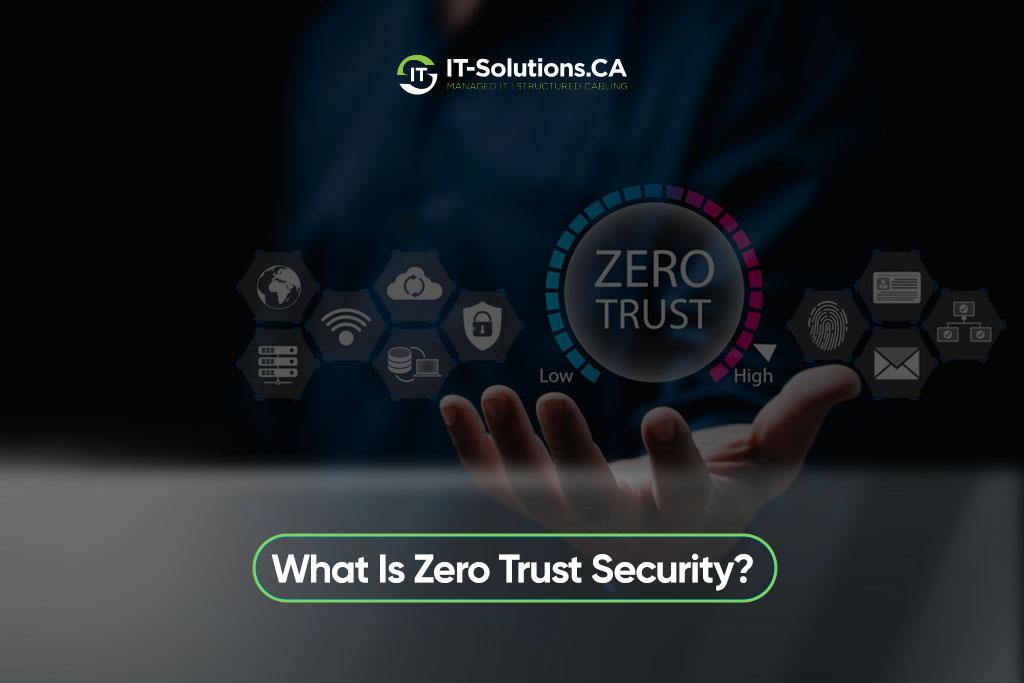
Zero trust security is a model built on one simple rule: never trust, always verify. No user, device, or request is trusted automatically, whether it comes from inside the office or the other side of the world. Every attempt to reach your data has to prove who it is and that it is allowed, every time.
The name says it plainly. Rather than trusting everything by default and watching for problems later, zero trust starts from the opposite place. It treats any request as a possible attacker until proven otherwise, then grants only the access that request actually needs.
Why The Old Security Model Fails Today
The traditional approach is often called castle-and-moat security. Everything inside the network wall was treated as safe, and the defences all pointed outward at the moat. The trouble is that the wall barely exists anymore, and a few shifts have worn it down for good.
Work now happens everywhere
Remote work, cloud software, and personal phones have spread your data far past any single boundary. When your people and systems are everywhere, there is no clean line between inside and outside left to defend.
Stolen passwords open the door
Once an attacker holds valid login details, the old model waves them through as a trusted user. That is not a rare event either, since credential abuse is the single most common way attackers break in, behind about 22% of breaches. A model that trusts anyone with a password is the wrong fit for that kind of threat.
One weak point exposes everything
In a castle-and-moat setup, breaking through the wall once often means access to the whole network. An attacker who gets in through a single laptop can move sideways toward servers and sensitive data with little standing in the way.
Core Ideas Behind Zero Trust
Zero trust rests on three plain principles that shape every decision the system makes.
Verify every time
Access is never granted on trust alone. Each request is checked against who the user is, what device they are on, and whether the request looks normal, and that check keeps happening throughout the session rather than once at login.
Give the least access needed
People and systems get only the access required to do their specific job, and nothing beyond it. If an account is ever compromised, the attacker is boxed into a small corner instead of the whole network.
Assume a breach will happen
Zero trust is built on the expectation that something will eventually get through. By planning for that from the start, it limits how far any single break-in can reach.
What Zero Trust Protects
Zero trust is not only about logins. It applies the same verify-first rule across every part of your environment that an attacker might target:
- Identities: Every user and service account proves who it is before gaining access
- Devices: Laptops, phones, and servers must be known and healthy to connect
- Networks: Segmentation keeps a threat from moving freely from one area to the next
- Applications and data: Access is granted per request, so sensitive files stay locked down
Treating each of these as its own checkpoint is what makes the model hard to slip past. An attacker who clears one hurdle still runs into the next.
What Zero Trust Looks Like in Practice
The principles above show up as a set of everyday controls and technologies working together:
- Multi-factor authentication: A password alone is never enough to get in
- Identity and access management: Central control over who can reach what, tied to each person’s role
- Zero Trust Network Access: Access to specific apps replaces the all-or-nothing reach of a traditional VPN
- Micro-segmentation: The network is split into sections so a threat cannot spread freely
- Continuous monitoring: Activity is watched in real time for anything unusual
No single tool delivers zero trust on its own, since it comes from these pieces working as one. That is why many businesses lean on a partner to fit them together. IT-Solutions.CA helps companies put these controls in place in stages, pairing zero trust with the firewall management, monitoring, and staff training that round out a full defence.
Why It Pays Off For Your Business
Zero trust does more than tighten security on paper, because its real value shows up when something goes wrong. Access is boxed in, and the network is segmented, so a single compromised account cannot reach everything at once. Ransomware that lands on one laptop is far less likely to spread to your servers, which often turns a company-wide disaster into a contained incident.
The savings back this up. Organizations with zero trust in place spend about $1.76 million less per breach on average than those without it. For a small business, avoiding even a fraction of that cost is the difference between a bad week and a closed door.
That is why working with an experienced IT Solutions Company can make implementation much more practical, helping businesses apply zero trust in a structured and cost-effective way.
Did You Know?
The term zero trust was coined in 2010 by analyst John Kindervag at Forrester, and it has since become the model behind the U.S. government’s own security mandate for federal agencies.
Where to Start With Zero Trust
Zero trust is a shift you make in stages, not a switch you flip overnight. A few first moves deliver most of the early protection:
- Turn on multi-factor authentication everywhere, since it blocks the stolen-password attacks behind most breaches.
- Map who has access to what, so you can see where accounts carry far more reach than they need.
- Cut access back to least privilege, removing permissions no one actually uses.
- Segment your network, so a problem in one area cannot spread across the whole business.
Working through these stages is where many businesses bring in help. IT-Solutions.CA maps out each step for companies across Toronto and beyond, so the rollout strengthens security without disrupting daily work.
Pro Tip:
Zero trust is a journey, not a purchase. Any vendor selling a single “zero trust product” is overpromising, because real zero trust comes from several controls set up to work together.
Is zero trust a product I can buy?
No, zero trust is a security model rather than a single product, though many tools support it. It comes from combining controls like multi-factor authentication, least-privilege access, and network segmentation into one approach, which is why it is adopted in stages instead of installed at once.
Is zero trust only for large companies?
No, small and mid-sized businesses often benefit the most, since attackers target them expecting weaker defences. Many zero trust steps, starting with multi-factor authentication, are practical and affordable for a business of any size.
Does zero trust replace my firewall and antivirus?
No, zero trust works alongside those tools rather than replacing them. A firewall and antivirus still have a role, while zero trust adds strict identity checks and limits how far any threat can move once it is inside.
What is the first step toward zero trust?
The first step is usually multi-factor authentication on every account, because stolen passwords are the leading cause of breaches. From there, businesses tighten access to least privilege and segment their network to limit the damage of any single incident.
Wrap Up
Zero trust security comes down to a simple change in thinking. Instead of trusting anyone who makes it inside the network, it checks every user and device and hands out only the access each one truly needs.
That change matters because the old perimeter is gone. Your people, devices, and data now sit everywhere at once, and zero trust keeps them safe by questioning every request and boxing in any threat that gets through.
You do not have to figure it out alone or all at once. IT-Solutions.CA provides IT Services and Support for businesses across Toronto, helping organizations strengthen their security for more than 15 years and guiding them through zero trust one practical step at a time.
See how we work and start closing the gaps the old model leaves wide open.
Author Profile

- Dedicated IT specialist with expertise in system administration, network security, and troubleshooting. Skilled at leveraging emerging technologies to boost efficiency, reduce risks, and ensure seamless IT operations while empowering teams to achieve their goals.
Latest entries
 BlogsOctober 14, 2026Managed IT vs. Break-Fix IT: Which Is Better for Your Business?
 BlogsOctober 13, 2026How Much Does A Microsoft 365 Security Audit Cost?
 BlogsSeptember 25, 2026How Often Should a Business Conduct a Cybersecurity Risk Assessment?
 BlogsSeptember 24, 2026How to Prepare Your Business for a Microsoft 365 Migration